Arthon (Indre)
Arthon est une commune française située dans le département de Indre, en région Centre-Val de Loire.
Informations administratives
| Code INSEE | 36009 |
| Code Postal | 36330 |
| Gentilé | Arthonnais |
Photos de Arthon
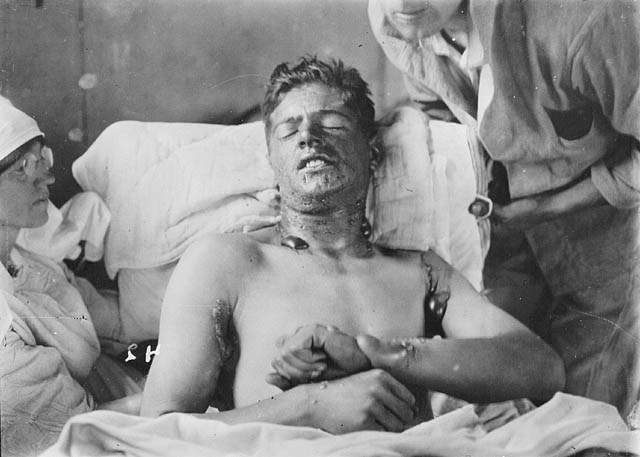
A Canadian soldier with mustard gas burns, ca. 1917-1918. par Balcer~commonswiki (Public domain)

Photograph of a gunnner chalking the message "I am the Hun's Father Christmas" on a 9.2 inch howitzer, France. par Rcbutcher (Public domain)
![A British officer writing home from the Western Front during World War One. Sitting on some sandbags and surrounded by scattered debris, this officer is writing a letter home. He is wearing puttees (protective leggings) over his lower legs. Mail to and from home was strictly censored during the conflict. Soldiers were not allowed to mention the name of wherever they were located. As many of the soldiers were illiterate, officers also had to read out and transcribe letters for the men. It is interesting to note that although the establishment was keen to suppress news and opinions about the war, the press did like to give the front line soldiers a voice. [Original reads: 'OFFICIAL PHOTOGRAPH TAKEN ON THE BRITISH WESTERN FRONT. An officer writing home.'] digital.nls.uk/74548100](https://upload.wikimedia.org/wikipedia/commons/f/fa/British_officer_writing_home_-_WWI_-_Western_Front.jpg)

![Carriages of a wrecked (freight?) train lying in a shell-hole beside bits of broken rail. There seems to be a group of people surveying the scene towards the top right of the picture. This picture has no 'Official Press' stamp. [Original reads: 'A shell-destroyed Train - Jct. of C' and C2o.'] http://digital.nls.uk/74549730](https://upload.wikimedia.org/wikipedia/commons/thumb/d/dc/Shell-destoyed_train_%284688505738%29.jpg/809px-Shell-destoyed_train_%284688505738%29.jpg)
Carriages of a wrecked (freight?) train lying in a shell-hole beside bits of broken rail. There seems to be a group of people surveying the scene towards the top right of the picture. This picture has no 'Official Press' stamp. [Original reads: 'A shell-destroyed Train - Jct. of C' and C2o.'] http://digital.nls.uk/74549730 par Ich (No restrictions)
![Soldiers in a trench, France, during World War I. A group of soldiers pose for the camera in a trench. All of them are wearing steel helmets and many of them are holding some form of weaponry. One man, third row back and third from the left, holds up a sign for '250 WILD WOODBINE CIGARETTES'. To the left we can just see what is possibly the entrance to a dugout. The landscape behind them is rather bleak. [Original reads: 'EUROPEAN WAR - WITH THE BRITISH FORCES IN FRANCE - A group in the trenches.'] http://digital.nls.uk/74545816](https://upload.wikimedia.org/wikipedia/commons/thumb/5/53/Group_in_the_trenches_%284688506942%29.jpg/960px-Group_in_the_trenches_%284688506942%29.jpg)
Soldiers in a trench, France, during World War I. A group of soldiers pose for the camera in a trench. All of them are wearing steel helmets and many of them are holding some form of weaponry. One man, third row back and third from the left, holds up a sign for '250 WILD WOODBINE CIGARETTES'. To the left we can just see what is possibly the entrance to a dugout. The landscape behind them is rather bleak. [Original reads: 'EUROPEAN WAR - WITH THE BRITISH FORCES IN FRANCE - A group in the trenches.'] http://digital.nls.uk/74545816 par Ich (No restrictions)
![Soldiers after raiding a German trench, France, during World War I. A group of soldiers pose for the camera. Some of them are smiling, while others have a look of determination. According to the photograph's original caption they have just returned from raiding a German trench. Two of the men are wearing German helmets, their trophies from the raid, while others are posing with rifle and bayonet. [Original reads: 'EUROPEAN WAR - WITH THE BRITISH FORCES IN FRANCE - A party who raided the German trenches.'] http://digital.nls.uk/74545812](https://upload.wikimedia.org/wikipedia/commons/thumb/a/a6/Party_who_raided_the_German_trenches_%284688507754%29.jpg/812px-Party_who_raided_the_German_trenches_%284688507754%29.jpg)
Soldiers after raiding a German trench, France, during World War I. A group of soldiers pose for the camera. Some of them are smiling, while others have a look of determination. According to the photograph's original caption they have just returned from raiding a German trench. Two of the men are wearing German helmets, their trophies from the raid, while others are posing with rifle and bayonet. [Original reads: 'EUROPEAN WAR - WITH THE BRITISH FORCES IN FRANCE - A party who raided the German trenches.'] http://digital.nls.uk/74545812 par Ich (No restrictions)
![Trench during World War I. An extremely wet and muddy trench. In the background there is a soldier sheltering from the rain, outside what could be the entrance to a dugout. Sandbags are piled up around the walls of the trench, to prevent collapse. Spades and other implements are strewn across the foreground, and there is a roll of barbed wire behind the burnt and blasted remains of a tree. Trench warfare was very harsh. A deadlock on the Western Front forced the respective armies to produce massively protected trench systems, and new weapons and tactics had to be devised. At first weaponry was desperately improvised, but then heavy artillery, such as Howitzer guns were brought in to obliterate the enemy's trench system and kill any soldiers on the open ground. [Original reads: No official caption.] http://digital.nls.uk/74545844](https://upload.wikimedia.org/wikipedia/commons/thumb/6/66/Wet_and_muddy_trench_%284687876853%29.jpg/806px-Wet_and_muddy_trench_%284687876853%29.jpg)
Trench during World War I. An extremely wet and muddy trench. In the background there is a soldier sheltering from the rain, outside what could be the entrance to a dugout. Sandbags are piled up around the walls of the trench, to prevent collapse. Spades and other implements are strewn across the foreground, and there is a roll of barbed wire behind the burnt and blasted remains of a tree. Trench warfare was very harsh. A deadlock on the Western Front forced the respective armies to produce massively protected trench systems, and new weapons and tactics had to be devised. At first weaponry was desperately improvised, but then heavy artillery, such as Howitzer guns were brought in to obliterate the enemy's trench system and kill any soldiers on the open ground. [Original reads: No official caption.] http://digital.nls.uk/74545844 par Ich (No restrictions)
![Labour Corps digging, Western Front, during World War I. This photograph shows five men of one of the Labour Corps groups, probably the South African Native Labour Contingent (SANLC) digging sand under the supervision of a native NCO. The purpose of their digging is unclear but it is possible that they were filling the ever-necessary sandbags. The Labour Corps included many non-European groups such as the South Africans, Egyptians, Chinese, Cape Coloured and Indian Corps. They were not only restricted from contact with white Europeans but were also segregated into different racially-determined Corps. [Original reads: 'Digging sand.'] http://digital.nls.uk/74549618](https://upload.wikimedia.org/wikipedia/commons/thumb/9/95/Labour_Corps_digging%2C_Western_Front%2C_during_World_War_I._This_photograph_shows_five_men_of_one_of_the_Labour_Corps_groups%2C_probably_the_South_African_Native_Labour_Contingent_%28SANLC%29_digging_sand_%284688531352%29.jpg/960px-thumbnail.jpg)
Labour Corps digging, Western Front, during World War I. This photograph shows five men of one of the Labour Corps groups, probably the South African Native Labour Contingent (SANLC) digging sand under the supervision of a native NCO. The purpose of their digging is unclear but it is possible that they were filling the ever-necessary sandbags. The Labour Corps included many non-European groups such as the South Africans, Egyptians, Chinese, Cape Coloured and Indian Corps. They were not only restricted from contact with white Europeans but were also segregated into different racially-determined Corps. [Original reads: 'Digging sand.'] http://digital.nls.uk/74549618 par Ich (No restrictions)
![Cooking in a labour camp, Western Front, during World War I. This photograph shows four men cooking and drinking soup from a British Army 'Soyer Stove'. They are all probably members of the South African Native Labour Contingent (SANLC) who were recruited to work in a non-military capacity on the Western Front as part of the Labour Corps. When the SANLC were recruited, the units tended to be organised on the basis of their homeland tribe or region. In part this was to avoid problems from traditional tribal feuds, but it also reflects the fear of the South African government that the different native groups would combine against the existing white rule. [Original reads: 'The soup kitchen.'] http://digital.nls.uk/74549612](https://upload.wikimedia.org/wikipedia/commons/thumb/e/e0/Cooking_in_a_labour_camp%2C_Western_Front%2C_during_World_War_I._This_photograph_shows_four_men_cooking_and_drinking_soup_from_one_of_the_army_outside_catering_boilers._They_are_all_probably_members_of_%284687898545%29.jpg/960px-thumbnail.jpg)
Cooking in a labour camp, Western Front, during World War I. This photograph shows four men cooking and drinking soup from a British Army 'Soyer Stove'. They are all probably members of the South African Native Labour Contingent (SANLC) who were recruited to work in a non-military capacity on the Western Front as part of the Labour Corps. When the SANLC were recruited, the units tended to be organised on the basis of their homeland tribe or region. In part this was to avoid problems from traditional tribal feuds, but it also reflects the fear of the South African government that the different native groups would combine against the existing white rule. [Original reads: 'The soup kitchen.'] http://digital.nls.uk/74549612 par Ich (No restrictions)
Données administratives
- Addresse : 7 place de la Mairie
36330 Arthon
- Email : mairie@arthon.fr
- Téléphone : 02 54 36 14 09
- Fax :
- Horaires :
- Le Lundi : 09:00:00 - 12:00:00 et 14:00:00 - 17:00:00
- Le Mardi : 09:00:00 - 12:00:00
- Le Mercredi : 09:00:00 - 12:00:00 et 14:00:00 - 17:00:00
- Le Jeudi : 09:00:00 - 12:00:00
- Le Vendredi : 09:00:00 - 12:00:00 et 14:00:00 - 17:00:00


![A British officer writing home from the Western Front during World War One. Sitting on some sandbags and surrounded by scattered debris, this officer is writing a letter home. He is wearing puttees (protective leggings) over his lower legs. Mail to and from home was strictly censored during the conflict. Soldiers were not allowed to mention the name of wherever they were located. As many of the soldiers were illiterate, officers also had to read out and transcribe letters for the men. It is interesting to note that although the establishment was keen to suppress news and opinions about the war, the press did like to give the front line soldiers a voice. [Original reads: 'OFFICIAL PHOTOGRAPH TAKEN ON THE BRITISH WESTERN FRONT. An officer writing home.'] digital.nls.uk/74548100](https://commons.wikimedia.org/wiki/File:British_officer_writing_home_-_WWI_-_Western_Front.jpg)
.jpg)
![Carriages of a wrecked (freight?) train lying in a shell-hole beside bits of broken rail. There seems to be a group of people surveying the scene towards the top right of the picture. This picture has no 'Official Press' stamp. [Original reads: 'A shell-destroyed Train - Jct. of C' and C2o.'] http://digital.nls.uk/74549730](https://commons.wikimedia.org/wiki/File:Shell-destoyed_train_(4688505738).jpg)
![Soldiers in a trench, France, during World War I. A group of soldiers pose for the camera in a trench. All of them are wearing steel helmets and many of them are holding some form of weaponry. One man, third row back and third from the left, holds up a sign for '250 WILD WOODBINE CIGARETTES'. To the left we can just see what is possibly the entrance to a dugout. The landscape behind them is rather bleak. [Original reads: 'EUROPEAN WAR - WITH THE BRITISH FORCES IN FRANCE - A group in the trenches.'] http://digital.nls.uk/74545816](https://commons.wikimedia.org/wiki/File:Group_in_the_trenches_(4688506942).jpg)
![Soldiers after raiding a German trench, France, during World War I. A group of soldiers pose for the camera. Some of them are smiling, while others have a look of determination. According to the photograph's original caption they have just returned from raiding a German trench. Two of the men are wearing German helmets, their trophies from the raid, while others are posing with rifle and bayonet. [Original reads: 'EUROPEAN WAR - WITH THE BRITISH FORCES IN FRANCE - A party who raided the German trenches.'] http://digital.nls.uk/74545812](https://commons.wikimedia.org/wiki/File:Party_who_raided_the_German_trenches_(4688507754).jpg)
![Trench during World War I. An extremely wet and muddy trench. In the background there is a soldier sheltering from the rain, outside what could be the entrance to a dugout. Sandbags are piled up around the walls of the trench, to prevent collapse. Spades and other implements are strewn across the foreground, and there is a roll of barbed wire behind the burnt and blasted remains of a tree. Trench warfare was very harsh. A deadlock on the Western Front forced the respective armies to produce massively protected trench systems, and new weapons and tactics had to be devised. At first weaponry was desperately improvised, but then heavy artillery, such as Howitzer guns were brought in to obliterate the enemy's trench system and kill any soldiers on the open ground. [Original reads: No official caption.] http://digital.nls.uk/74545844](https://commons.wikimedia.org/wiki/File:Wet_and_muddy_trench_(4687876853).jpg)
![Labour Corps digging, Western Front, during World War I. This photograph shows five men of one of the Labour Corps groups, probably the South African Native Labour Contingent (SANLC) digging sand under the supervision of a native NCO. The purpose of their digging is unclear but it is possible that they were filling the ever-necessary sandbags. The Labour Corps included many non-European groups such as the South Africans, Egyptians, Chinese, Cape Coloured and Indian Corps. They were not only restricted from contact with white Europeans but were also segregated into different racially-determined Corps. [Original reads: 'Digging sand.'] http://digital.nls.uk/74549618](https://commons.wikimedia.org/wiki/File:Labour_Corps_digging,_Western_Front,_during_World_War_I._This_photograph_shows_five_men_of_one_of_the_Labour_Corps_groups,_probably_the_South_African_Native_Labour_Contingent_(SANLC)_digging_sand_(4688531352).jpg)
![Cooking in a labour camp, Western Front, during World War I. This photograph shows four men cooking and drinking soup from a British Army 'Soyer Stove'. They are all probably members of the South African Native Labour Contingent (SANLC) who were recruited to work in a non-military capacity on the Western Front as part of the Labour Corps. When the SANLC were recruited, the units tended to be organised on the basis of their homeland tribe or region. In part this was to avoid problems from traditional tribal feuds, but it also reflects the fear of the South African government that the different native groups would combine against the existing white rule. [Original reads: 'The soup kitchen.'] http://digital.nls.uk/74549612](https://commons.wikimedia.org/wiki/File:Cooking_in_a_labour_camp,_Western_Front,_during_World_War_I._This_photograph_shows_four_men_cooking_and_drinking_soup_from_one_of_the_army_outside_catering_boilers._They_are_all_probably_members_of_(4687898545).jpg)