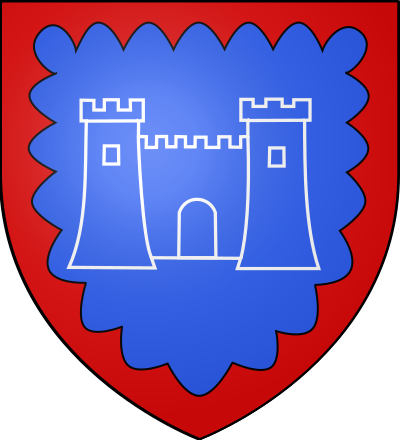
 Châteauvieux
Informations
| Code INSEE | 41042 |
| Code Postal | 41110 |
| Gentilé | Castelviezins |

Le château d'origine médiévale fut constamment habité. Il passa par héritage en 1821 à Augustine Marie Rosalie de Forges de Châteaubrun (1772-1853), épouse de Pierre-Paul Royer-Collard (1763-1845). Issu d’une famille de la bourgeoisie rurale de la Marne, Pierre-Paul Royer-Collard devint avocat. Il participa aux évènements révolutionnaires. Proche des Girondins, il dut quitter Paris durant la Terreur. En 1797, il devint membre du Conseil des Cinq-Cents pour le département de la Marne. Il en fut exclu suite au coup d’Etat du 18 fructidor en IV. Partisan de la monarchie constitutionnelle, il entra au conseil secret du comte de Provence, futur Louis XVIII. Après le coup d'État du 18 Brumaire, l'espoir d'un retour à la royauté disparaît et Royer-Collard se rapproche de l'Empire. Professeur d’histoire de la philosophie moderne à la Sorbonne, il prit en 1815 la direction de la Commission de l'Instruction publique. En 1816, il obtint l'instruction communale gratuite. La même année, il devint le porte-parole des "doctrinaires", qui voulaient un retour à une monarchie tempérée, contre les "ultras" qui voulaient une restauration pure et simple. En 1820, suite a l'arrivée au pouvoir des "ultras", Entré dans l’opposition, il se rapprocha de François Guizot avec lequel il créa la société "Aide toi, le ciel t’aidera". En 1828, il revint au premier plan comme président de la Chambre des députés (il fut la même année élu à l’Académie française). C'est à ce titre que le 18 mars 1830 il présente l'adresse des 221 à Charles X, prélude à la Révolution de juillet 1830. Sous Louis-Philippe, il siège encore à l'Assemblée nationale mais il s'éloigne de la vie politique. Il juge la démocratisation trop rapide et dangereuse. Il passa les dernières années de sa vie à fréquenter assidument ses amis et voisins, en particulier Talleyrand. Royer-Collard défendit le principe de la séparation de l’Église et de l’État, mais il le fit parce qu’il considérait que laisser le pouvoir temporel agir sur la religion était un rabaissement de cette dernière. The medieval castle was constantly inhabited. He passed by inheritance in 1821 to Augustine Marie Rosalie Forges Chateaubrun (1772-1853), wife of Pierre-Paul Royer-Collard (1763-1845). Coming from a family of rural bourgeoisie of the Marne, Pierre-Paul Royer-Collard became a lawyer. He participated in the revolutionary events. Close to the Girondins, he had to leave Paris during the Terror. In 1797 he became a member of the Council of Five Hundred for the department of Marne. He was expelled following the coup of 18 Fructidor in IV. Supporter of constitutional monarchy, he entered the secret counsel of the Count of Provence, the future Louis XVIII. After the coup d'état of 18 Brumaire, the hope of a return to monarchy disappears and Royer-Collard approximates the Empire. Professor of history of modern philosophy at the Sorbonne in 1815 he took the direction of the Commission of Public Instruction. In 1816, he received instruction communal free. The same year, he became the spokesman for the "doctrinaire" who wanted a return to monarchy, against the "ultras" who wanted to restore pure and simple. In 1820, following the rise to power has the "ultras" Joined the opposition, he approached François Guizot, with whom he founded the company "Help yourself, heaven help you." In 1828, he returned to the forefront as president of the Chamber of Deputies (the same year he was elected to the French Academy). It is for this reason that March 18, 1830 it has the address of 221 to Charles X, a prelude to the Revolution of July 1830. Under Louis-Philippe, it still serves the National Assembly, but he distanced himself from politics. It considers democratization too fast and dangerous. He spent the last years of his life to attend assiduously his friends and neighbors, especially Talleyrand. Royer-Collard defended the principle of separation of church and state, but he did it because he felt that leaving the temporal power to act on religion was a lowering of the latter. par Thesupermat2 (CC BY 2.0)

Le château d'origine médiévale fut constamment habité. Il passa par héritage en 1821 à Augustine Marie Rosalie de Forges de Châteaubrun (1772-1853), épouse de Pierre-Paul Royer-Collard (1763-1845). Augustine-Angélique Royer-Collard (1808-1874), fille des deux précédents, hérita du domaine. Elle épousa Gabriel ANDRAL (1797-1876), fils du médecin de Caroline Bonaparte. (Tous deux reposent dans le caveau de Châteauvieux). Leur fils, Charles Guillaume Paul ANDRAL (1828-1889) prit leur succession. Avocat, il devint en 1873 Vice-président du Conseil d’Etat. Il abandonna ensuite la magistrature et devint directeur du réseau de chemins de fer Paris Orléans. Il épousa Blanche Delius, d’origine juive et convertie au christianisme. Il mourut en 1889 et fut inhumé dans le cimetière, qui fut désaffecté l’année suivante. Blanche décéda à 88 ans en 1925. Elle fut inhumée au Père Lachaise à Paris. Sans héritiers, elle légua le domaine de Châteauvieux à la Société Philanthropique de Paris, pour y installer une maison de repos sous la direction d’une communauté religieuse, pour dames et jeunes filles fatiguées. En 1998, l’établissement fut transformé en maison de retraite médicalisée. The medieval castle was constantly inhabited. He passed by inheritance in 1821 to Augustine Marie Rosalie Forges Chateaubrun (1772-1853), wife of Pierre-Paul Royer-Collard (1763-1845). Angelique Augustine Royer-Collard (1808-1874), daughter of the previous two, inherited the estate. She married Gabriel ANDRAL (1797-1876), son of the doctor Caroline Bonaparte. (Both are buried in the vault of Châteauvieux). Their son, Charles William Paul ANDRAL (1828-1889) took their inheritance. Lawyer, in 1873 he became Vice-President of the Council of State. Then he left the bench and became director of the network of railways Paris Orléans. He married Blanche Delius, of Jewish and converted to Christianity. He died in 1889 and was buried in the cemetery, which was abandoned the following year. White died at age 88 in 1925. She was buried in Père Lachaise in Paris. Without heirs, she bequeathed the field Châteauvieux the Philanthropic Society of Paris, to install a nursing home under the direction of a religious community, for ladies and girls tired. In 1998, the facility was transformed into nursing home. par Thesupermat2 (CC BY 2.0)

L'église Saint Hilaire, de style gothique angevin dans sa partie la plus ancienne. En 1144, une bulle confie aux moines de l'abbaye de Pont-le-Voy, la fondation d'une église dédiée à Saint Hilaire. L'église est établie auprès du château. De plan rectangulaire, elle est constituée d'une nef formée de trois travées carrées de style angevin, voûtées d'ogives bombées et à liernes, et d'un choeur moins large, achevé par un chevet droit percé d'un triplet de baies. La chapelle seigneuriale au nord du choeur date du XVe. Jehan IV Roüy entreprit la construction de la chapelle seigneuriale pour servir de nécropole aux châtelains. Le clocher est ajouté à droite de la façade au XIXe par l'architecte LAFARGUE, qui construit aussi la chapelle sud et la sacristie dans son prolongement. The church of Saint Hilaire, Angevin Gothic in its oldest part. In 1144, a bull says to the monks of the Abbey of Pont-le-Voy, the foundation of a church dedicated to St. Hilaire. The church is set up at the castle. Rectangular plan, it consists of a nave of three bays formed square style Anjou, vaulted arches and curved liernes and a narrower choir, completed by a bedside right pierced by a triple berries. The stately chapel north of the chancel dates from the fifteenth. Jehan Rouy IV began the construction of the stately chapel to serve the lords necropolis. The tower is added to the right of the façade by the architect nineteenth LAFARGUE, which also built the south chapel and sacristy in its extension. par Thesupermat2 (CC BY 2.0)

La montée au château. The climb to the castle. par Thesupermat2 (CC BY 2.0)

Le château d'origine médiévale, a évidemment été construit à un endroit stratégique. Il s'agissait probablement d'interdire l'accès de la vallée. Le château tomba dans les mains des "Anglais" (1356) pendant la guerre de Cent Ans. En réalité, il s'agissait de seigneurs bien français mais alliés des comtes d'Anjou (les Plantagenêts) qui étaient également rois d'Angleterre. Après le traité de Brétigny (8 mai 1360), le château fut racheté et détruit pour éviter que les Anglais ne s'en emparent de nouveau. Un nouveau château sera construit, le calme revenu, par Loÿs (Louis) ROUHY ou ROÜY, seigneur de Menetou, de Péquignon par acquisition en 1385 et de Châteauvieux par acquisition en 1395. Il a épousé Jehanne BELLON. The medieval castle, was obviously built in a strategic location. It was probably to prevent access to the valley. The castle fell into the hands of the "English" (1356) during the Hundred Years War. In fact, it was very French lords but allies of the Counts of Anjou (the Plantagenets) who were also kings of England. After the Treaty of Brétigny (8 May 1360), the castle was bought and destroyed to prevent the English seize it again. A new castle was built, calmed by Loÿs (Louis) or ROUHY Rouy Menetou lord of Péquignon by acquisition in 1385 and acquired in 1395 by Châteauvieux. He married Joan BELLON. par Thesupermat2 (CC BY 2.0)

L'ancien cimetière paroissial avec le calvaire et la tombe de Royer-Collard. L’histoire de ce cimetière est liée à la famille qui occupa le château. Le château d'origine médiévale fut constamment habité. Il passa par héritage en 1821 à Augustine Marie Rosalie de Forges de Châteaubrun (1772-1853), épouse de Pierre-Paul Royer-Collard (1763-1845). Pierre-Paul mourut en premier et fut inhumé dans ce cimetière, dans l'enclos familial. Son épouse décéda huit ans plus tard mais fut inhumée au cimetière Montparnasse. The old parish cemetery with Calvary and the tomb of Royer-Collard. The history of this cemetery is related to the family who occupied the castle. The medieval castle was constantly inhabited. He passed by inheritance in 1821 to Augustine Marie Rosalie Forges Chateaubrun (1772-1853), wife of Pierre-Paul Royer-Collard (1763-1845). Pierre-Paul died first and was buried in the cemetery, in the family enclosure. His wife died eight years later but was buried in Montparnasse Cemetery. par Thesupermat2 (CC BY 2.0)


- Addresse : 1 rue des Déportés-du-2-Mai-1944
41110 Châteauvieux
- Email : mairie@chateauvieux41.fr
- Téléphone : 02 54 75 21 06
- Fax : 02 54 75 46 26
- Horaires :
- Du Lundi au Vendredi : 08:00:00 - 12:15:00

._(8631784714).jpg)
._(8630681827).jpg)
._(8631786128).jpg)
._(8631783514).jpg)
._(8630683273).jpg)
._(8631787294)_(2).jpg)
_-_444.jpg)
_-_443.jpg)
_-_445.jpg)
_-_446.jpg)