 Châteaubriant
Informations
| Code INSEE | 44036 |
| Code Postal | 44110 |
| Gentilé | Castelbriantais |


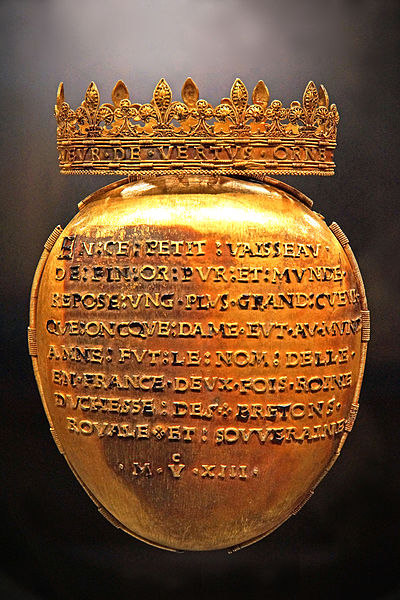
On the occasion of the fifth centenary of the death of the Duchess of Brittany, the Department offers an exceptional exhibition of fabulous funeral casket. Nearly 80 works are grouped around the gold heart. Queen Anne, duchess of Brittany, born on 25 January 1477, died at the Royal Château of Blois on 9 January 1514 at the age of 37. Louis XII wanted to offer the queen a funeral of unaccustomed splendour, which lasted forty days and was celebrated in three phases : the ceremonies in Blois, the halts along the road from Blois to Paris (from the 3rd to the 14th of February), and the burial at Saint Denis (16 February). Queen of France, Anne knew that her body would be buried at Saint Denis. To mark her attachment to her Breton subjects, she wanted her heart to rest in the tomb of her parents at the church of the Carmelites in Nantes. According to her will, Anne's heart was placed in a raised enamel gold reliquary. par Jacopo Werther (CC BY-SA 2.0)

Cast iron model of Château de Châteaubriant made around 1938 by Louis Guegan. Ten centuries at a glance. Overlooking the River Chere, the square keep dominates the double wall of the imposing medieval fortress. To the west lies the inner bailey, the lord’s place of residence flanked by a pair od dwellings at right angles and the chapel. The large outer bailey to the east was the living quarters for servants, soldiers and their families. Following the siege of 1488, the decision was taken to build a new Renaissance castle here, This was to serve residential rather than military purposes. The dwellings, extended to include galleries, now featured gardens and greater viewpoints on to more open architecture. par Jacopo Werther (CC BY-SA 2.0)


- Addresse : Place Ernest-Bréant
44110 Châteaubriant
- Email : mairie@ville-chateaubriant.fr
- Téléphone : 02 40 81 02 32
- Fax :
- Horaires :
- Du Lundi au Jeudi : 08:30:00 - 12:00:00 et 13:30:00 - 17:30:00
- Le Vendredi : 08:30:00 - 12:00:00 et 13:30:00 - 17:00:00
- Le Samedi : 09:00:00 - 12:00:00

.jpg)
.jpg)
.jpg)
.jpg)
.jpg)
.jpg)
.jpg)
.jpg)
.jpg)
.jpg)